The Death of Jesus
Welcome To New Berlin Road Church, where we want you to Gather Grow and Go
WHAT HAPPENED WHEN JESUS DIED?
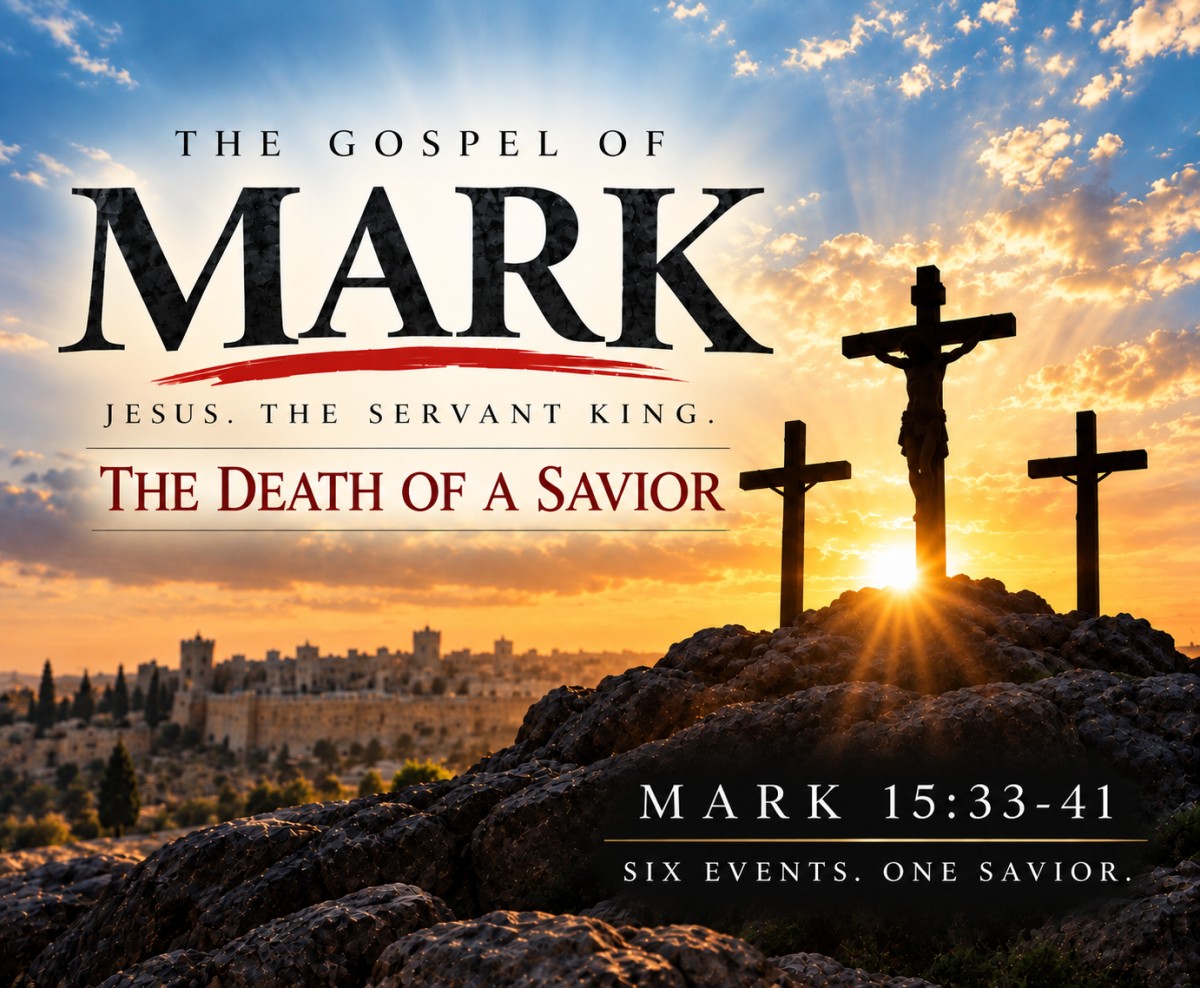
Mark 15:33-41
Gospel of Mark Series - Jesus, the Servant King
| Mark surrounds Jesus' death with signs and witnesses that reveal the meaning and significance of the cross. |
| EVERYTHING CHANGED WHEN JESUS |
There are moments in history that change everything that comes after them. There was a world before that moment and a different world after it.
But no moment in human history changed more than the moment Jesus Christ died on the cross.
Mark does not merely tell us THAT Jesus died. He shows us WHAT His death means.
The Seven Sayings From the Cross
1."Father, forgive them..." - Luke 23:34
2."Today you will be with Me in Paradise." - Luke 23:43
3."Woman, behold your son..." - John 19:26-27
4."My God, My God, why have You forsaken Me?" - Mark 15:34
5."I thirst." - John 19:28
6."It is finished." - John 19:30
7."Father, into Your hands I commit My spirit." - Luke 23:46
Mark focuses our attention on six events surrounding Jesus' death, and each one helps us understand what happened.
The Cross Was Always God's Plan
·Psalm 22 - Messiah mocked and His garments divided.
·Isaiah 53 - Numbered with transgressors.
·Amos 8:9 - Darkness at midday.
·Psalm 22:1 - "My God, My God, why have You forsaken Me?"
·Isaiah 53 - Burial with the rich.
NONE OF THIS WAS AN ACCIDENT. The cross was not Plan B. The cross was God's plan of redemption.
1. THE DARKNESS - JUDGMENT FELL
Mark 15:33
"When the sixth hour came, darkness fell over the whole land until the ninth hour."
·Sixth hour = Noon
·Ninth hour = 3:00 PM
·Darkness at noon was not merely a weather report.
·Throughout Scripture, darkness is associated with divine judgment.
·Amos 8:9 - "I will make the sun go down at noon..."
When Jesus was born, the night filled with light. When Jesus died, the daylight filled with darkness.
JESUS WAS BEARING THE JUDGMENT OUR SIN DESERVED.
Isaiah 53:5 - He was pierced because of our rebellion, crushed because of our iniquities; punishment for our peace was on Him.
·OUR rebellion.
·OUR iniquities.
·OUR punishment.
Jesus was not dying for His sin. He did not have any. He was dying for ours.
The darkness was not because God had lost control. The darkness was because judgment was falling - and Jesus was standing in our place.
2. THE CRY - JESUS BORE OUR SIN
Mark 15:34-36
"My God, My God, why have You forsaken Me?"
Jesus is quoting Psalm 22:1. Psalm 22 describes mocking, humiliation, piercing, divided garments, and casting lots for clothing.
Notice: Jesus says "My God, My God," not "My Father, My Father."
·Jesus did not stop being the eternal Son.
·The Trinity was not destroyed.
·The Father did not stop loving the Son.
·The sinless Son of God was bearing the judgment of sinners.
2 Corinthians 5:21 - "He made the One who did not know sin to be sin for us..."
He carried my sin. He carried your sin. The One who knew no sin stood in the place of sinners.
SUBSTITUTIONARY ATONEMENT: HE TOOK MY PLACE.
·That cross should have been mine.
·That judgment should have been mine.
·That punishment should have been mine.
·But Jesus took my place.
Jesus was treated as our sin deserved so that we could be treated as His righteousness deserves.
3. THE FINAL CRY - THE WORK WAS FINISHED
Mark 15:37
"Jesus let out a loud cry and breathed His last."
John 19:30 gives us the words: "It is finished."
Tetelestai = Completed. Accomplished. Paid in full.
Jesus did not say, "I am finished." He said, "IT is finished."
·The price had been paid.
·The sacrifice had been offered.
·Atonement had been accomplished.
·The work of salvation was done.
Hebrews 10:12 - "After offering one sacrifice for sins forever, sat down at the right hand of God."
Religion says: DO.The Gospel says: DONE.
Your salvation does not rest on what you can do for God. Your salvation rests on what Christ has already done for you.
4. THE CURTAIN - THE WAY WAS OPENED
Mark 15:38
"Then the curtain of the temple was torn in two from top to bottom."
THIS IS GOD'S COMMENTARY ON THE CROSS.
The curtain separated the Holy Place from the Holy of Holies. For generations it declared: YOU CANNOT COME IN.
·God is holy.
·Sinful humanity is separated from Him.
·Only the high priest could enter.
·Only once a year.
·Only with sacrificial blood.
But when Jesus died, THE CURTAIN TORE - from top to bottom. God tore it. God opened the way.
The Torn Curtain Tells Us Three Things
1. Jesus' sacrifice is perfect and sufficient. No other sacrifice is necessary.
2. The Old Testament sacrificial system was fulfilled in Christ.
3. God is accessible to everyone who comes through faith in Jesus Christ.
Hebrews 10:19-20 - We enter God's presence "through the blood of Jesus."
·You do not need another priest.
·You do not need another sacrifice.
·You do not need religion.
·YOU NEED JESUS.
John 14:6 - "I am the way, the truth, and the life. No one comes to the Father except through Me."
The price was paid. The sacrifice was complete. The way to God was opened.
5. THE CONFESSION - JESUS WAS REVEALED
Mark 15:39
The centurion watched Jesus beaten, mocked, crucified, heard His cries, and watched Him die.
"Truly this man was the Son of God!"
Mark 1:1 begins: "The beginning of the gospel of Jesus Christ, the Son of God."
·Not a religious leader.
·Not a priest.
·Not a scribe.
·A Roman centurion - a Gentile - confesses Him.
Throughout Mark the question has been: WHO IS JESUS?
·The demons knew.
·The disciples struggled.
·The crowds wondered.
·The religious leaders rejected Him.
·The centurion confessed Him.
There is a difference between knowing ABOUT Jesus and knowing WHO Jesus is.
WHAT WILL YOU DO WITH JESUS?
6. THE WITNESSES - JESUS REALLY DIED
Mark 15:40-41
Mark names the women who were watching: Mary Magdalene, Mary the mother of James the younger and Joses, Salome, and others who had followed Jesus.
THEY WERE EYEWITNESSES.
·They saw Him die.
·They knew where He was buried.
·These same women would soon witness the empty tomb.
The Gospel is not that Jesus might have died or appeared to die.
JESUS REALLY DIED. JESUS REALLY WAS BURIED. JESUS REALLY ROSE AGAIN.
1 Corinthians 15:3-4 - Christ died for our sins according to the Scriptures, He was buried, and He was raised on the third day according to the Scriptures.
These women saw Friday. They were about to see Sunday.
SO WHAT HAPPENED WHEN JESUS DIED?
| EVENT | WHAT IT MEANS |
| Darkness covered the land | Judgment was falling. |
| Jesus cried out | He was bearing our sin. |
| Jesus died | Redemption was accomplished. |
| The curtain tore | The way to God was opened. |
| The centurion confessed | Jesus was revealed as the Son of God. |
| The women witnessed it | Jesus truly died - and resurrection morning was coming. |
EVERYTHING CHANGED WHEN JESUS DIED
There was a debt we could not pay. JESUS PAID IT.
There was judgment we could not escape. JESUS TOOK IT.
There was righteousness we could not earn. JESUS PROVIDED IT.
There was a curtain we could not cross. JESUS TORE IT.
There was a God we could not reach by our own goodness. JESUS OPENED THE WAY.
There was death we could not defeat. JESUS WALKED OUT OF THE GRAVE.
THAT'S THE GOSPEL.
WHERE DO YOU STAND?
Everybody in Mark 15 stood somewhere around the cross.
·Some mocked Him.
·Some rejected Him.
·Some watched from a distance.
·One confessed Him.
WHERE DO YOU STAND WITH JESUS?
The Gospel calls us to REPENT AND BELIEVE.
Jesus did not die to make you a slightly better person. Jesus died because you needed to be saved.
Romans 5:8 - "While we were still sinners, Christ died for us."
You do not clean yourself up first. You do not earn your way through the curtain. THE CURTAIN HAS ALREADY BEEN TORN.
·Through Christ.
·By grace.
·Through faith.
·Because of what Jesus accomplished on the cross.
"IT IS FINISHED."
The question is not: Have you done enough?
DO YOU TRUST WHAT JESUS HAS DONE?
·Jesus took your place.
·Jesus bore your judgment.
·Jesus paid your debt.
·Jesus opened the way.
·Jesus invites you to come.
EVERYTHING CHANGED.
·The judgment was borne.
·The debt was paid.
·The sacrifice was completed.
·The curtain was torn.
·The way was opened.
·The Son of God was revealed.
And because Friday was not the end of the story - SUNDAY IS COMING.